Rock Bags
The failure mode is puncture, not overload
A bag can be well within its safe working load and still fail with rock in it. Angular material concentrates the entire load onto whatever small area of fabric a broken face happens to be resting against, and it works — slowly, every time the bag is moved — into the weave until it finds a way through.
That means the specification question for rock is not “how much will it hold”. It is how the fabric resists a point load, how tightly it is woven, and how the vertical seams are built. Those are different properties from tensile strength, and a bag can be excellent at one and poor at the others.
What we change, and what we do not
Compared with a bag built for round or crushed aggregate, a rock bag gets a heavier and tighter weave, upgraded seam construction, and usually a multi-trip safety factor because rock bags tend to be moved more than once. What does not change is the arithmetic: we still size from fill weight rather than from cubic capacity, for the same reason we do it on gravel and aggregate bags — a bag that looks half empty can already be past its rating.
The practical consequence is that a rock bag and a gravel bag of the same stated capacity are not interchangeable in either direction. Putting drain rock in a bag specified for armour stone works and is simply more bag than you needed. The reverse does not work, and it fails in a way that looks like a manufacturing defect.
The stock rock bag
The one we hold in inventory is 27” x 27” x 26” — a third of a cubic yard — rated to a 3,300 lb safe working load, 225 to a pallet, built on a 5:1 safety factor with a document pouch. It is deliberately the smallest bag in the stock line and the strongest: a third of a yard of rock already outweighs a full yard of most other things, and a bag a crew can actually pick when it is full beats a larger one they cannot. Work past what that covers is specified from scratch.
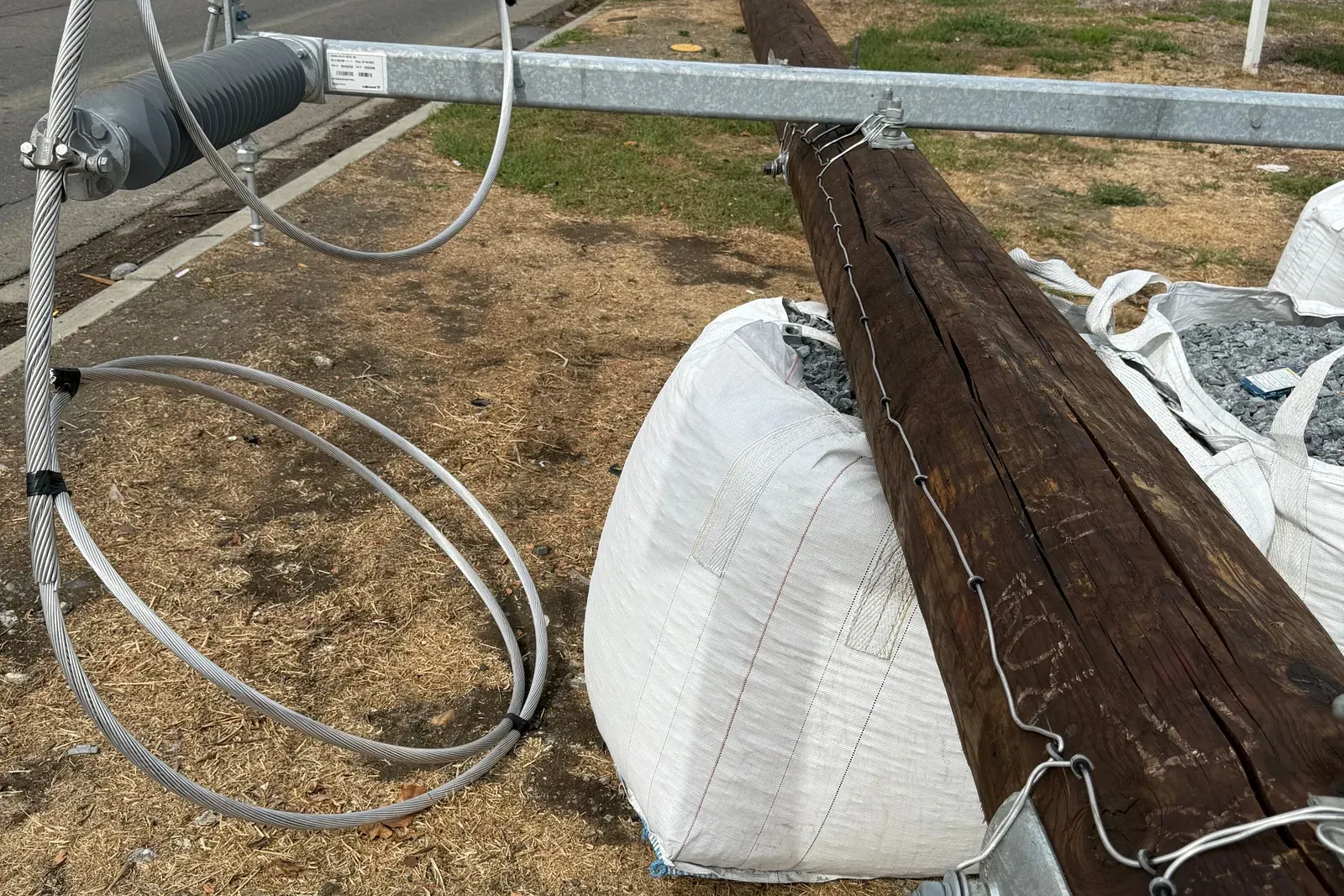
Pole setting and utility work
Utility crews were among the first customers for these bags and they remain a good share of what we ship. Pole setting means getting gravel and tools to a structure no truck can reach, so the bag usually arrives slung under a helicopter or carried in on a track machine. That changes the specification. A slung load hangs from all four loops on a single hook and it moves in the air, and none of that is described by a safe working load measured on a static, square forklift pick.
We supply totes for pole setting backfill, and we keep a list of suppliers who will deliver the material already in totes if that is easier than filling on site. Tell us how the bag travels and what it is carrying, and the loops and the fabric around them get specified for that rather than for a warehouse floor.
Tell us about the worst piece in the load
The most useful sentence in a rock enquiry is a description of the sharpest, largest material in the load rather than the average. Run-of-crusher material with a small percentage of sharp fractions will find the weak point in a bag specified for the mean. Graded, washed rock of a consistent size is a much easier problem, and we can spec it more economically once we know that is what it is.
Wet or submerged placement is worth flagging in the same breath. A saturated bag weighs noticeably more than its dry fill weight, and sustained water exposure is a separate question from sun exposure. Neither is a problem; both are specification inputs.
Where these bags end up
Rock bags do most of their work in two places. The first is erosion control and channel restoration, where the filled bag is placed and then stays — becoming part of the structure rather than a container that gets emptied. Long outdoor life and predictable behaviour under load matter more there than anything else, and UV treatment stops being optional.
The second is energy infrastructure: access roads, pad armour and scour protection along transmission corridors, where material is staged outdoors for weeks and the site may be a long way from anywhere. On a corridor job the resupply distance is the real cost of a failed bag, which is a good argument for specifying above the line rather than at it.
If what you are moving is classified rather than merely heavy — mine reagents, treated material, anything with a shipping name — the strength question is not the governing one. Hazmat bulk bags are specified against the material’s classification first, and construction second.
Getting a number
Send the size range, how angular the material is, how the bag gets handled and where it is going. Request a quote with that and we can specify it; if it is easier to describe than to write down, call us and we will work through it on the phone.
Why this spec, for rock bags
Specified against puncture
Rock fails a bag from the inside with a point load, not by exceeding its rating. The specification question is fabric resistance to a sharp edge under pressure, which is a different property from tensile strength.
Heavier weave, tighter construction
A denser weave gives a sharp fraction less room to work its way between yarns. It is the single biggest difference between a bag that survives armour stone and one that does not.
Seam protection where it matters
Vertical seams are where a loaded rock bag concentrates stress and where a sharp piece finds a path out. Seam construction and thread specification are quoted, not assumed.
Built for repeat handling
Rock bags are frequently placed, moved and re-picked rather than filled and emptied once. Where that is the case we specify a multi-trip 6:1 safety factor and say so on the quote.
Sized for the placing equipment
A bag destined to be set by excavator into a channel is a different shape problem than one going onto a flatbed. Tell us how it gets placed and the dimensions follow from that.
From your material to a specification
The same four questions on every quote. They decide fabric weight, seam construction, safety factor and closure — dimensions come last.
Describe the rock, not just the tonnage
Size range, how angular it is, and whether it arrives graded or as run-of-crusher. A sharp fraction in an otherwise round load governs the specification.
Tell us how it gets handled
Filled once and placed, or picked and moved repeatedly. That decides single-trip against multi-trip and the safety factor that comes with it.
Confirm the spec in writing
Fabric weight, weave, seam construction, safe working load and safety factor, all on the quote before production.
Delivery to the site
To the yard or straight to the working face. Remote sites need a delivery window set when the order is placed, not after.
Rock Bags: the questions we get asked
Why can I not just use a heavier gravel bag for rock?
Because the failure mode is different. Gravel overloads a bag; rock cuts it. Adding fabric weight raises the load rating but does very little for puncture resistance, which comes from how tightly the fabric is woven and how the seams are built. A heavier bag of the wrong construction fails in the same place, just later.
Will a liner protect the bag from sharp rock?
No, and it is worth being clear about it. Liners are for containment of fines and dust, not for mechanical protection. A polyethylene liner gives a sharp edge no meaningful resistance. The protection has to be in the outer fabric and the seams.
Can rock bags be left in place permanently?
They are often used that way in erosion control and channel work, and that is a specification question rather than a yes or no. A bag that stays outdoors indefinitely needs UV treatment, and it needs to be understood as a temporary-to-medium-term structure. We will tell you what the realistic service life looks like for the exposure you describe.
What size range works best in a bag?
Anything from crushed rock up through cobble-sized material bags well. Very large individual pieces are the problem — a single stone taking up much of the bag's height concentrates load onto a small area of fabric and defeats the construction. If you are handling material at that scale, tell us the largest piece rather than the average.
Can these bags be flown to a pole site by helicopter?
Yes, and it is one of the more common things we specify for. A slung load hangs from all four loops on one hook and it moves in the air, so the loop attachment and the fabric around it matter more than the flat safe working load figure does. Tell us the aircraft, the intended load and whether the bag is released or set down, and the loops get specified for that.
Do you supply bags for wet or submerged placement?
Yes, and it changes two things: the bag is heavier than its dry fill weight suggests, and sustained wet exposure matters to the fabric. Say up front that the bag goes into water so both get accounted for in the specification.