UN Certified Bulk Bags
What certification means here
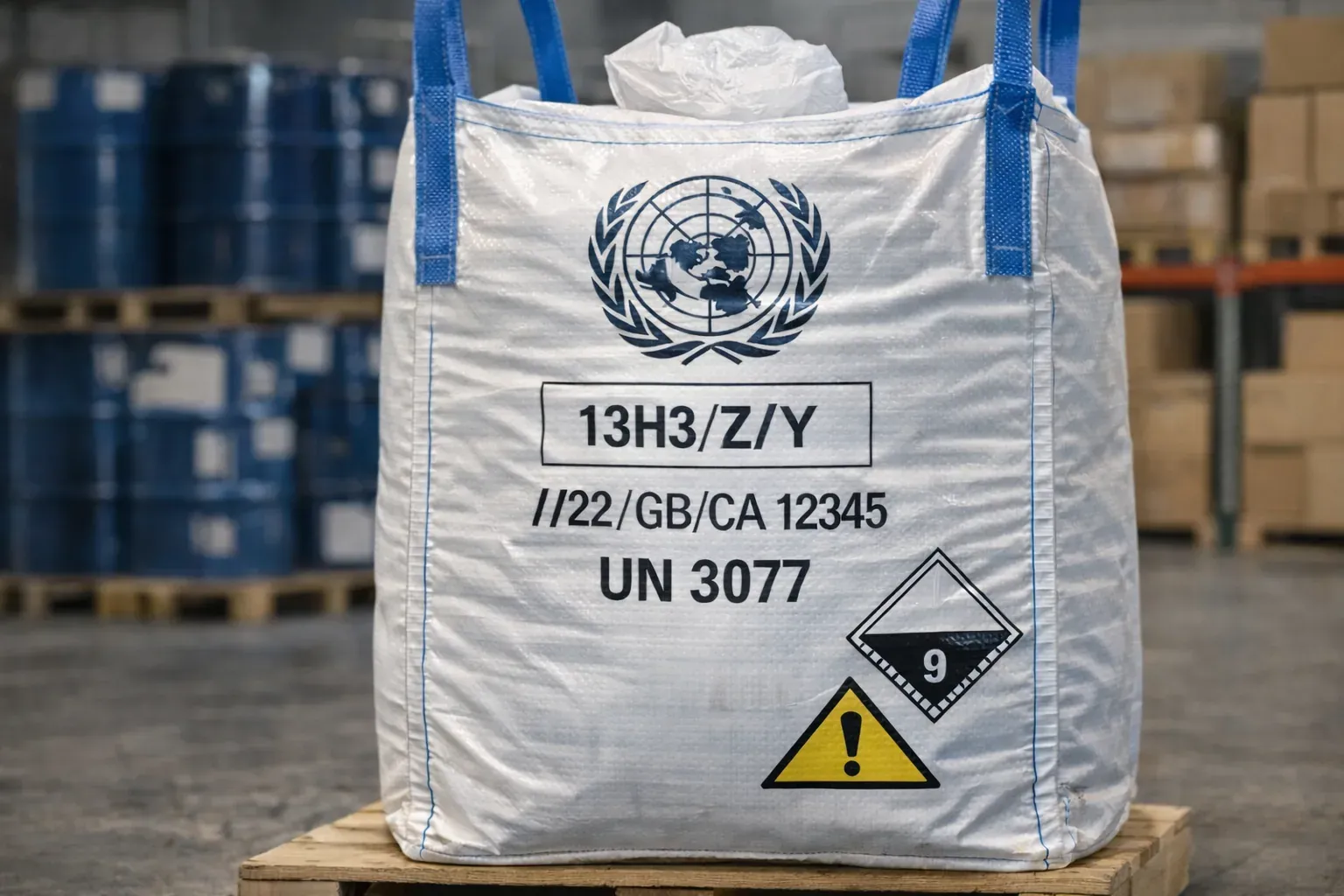
A UN certified FIBC has been through a defined test regime and carries a marking that records the result. The tests cover dropping, toppling, righting and stacking, at a severity set by the packing group the package is certified for.
That is the whole value of the certification: it is evidence, produced by testing, that this package design holds the class of material it claims to hold.
Certification only holds if you use it as tested
The most common way a certified package stops being compliant is in use, not in manufacture. Filling past the marked gross mass, closing it differently from the tested configuration, or using a package certified for packing group III to ship packing group II material — each of these voids the basis of the certification while the marking still reads perfectly fine.
Tell us the classification and the gross mass you need per bag, and we will quote a package that is actually certified for it.
The marking is the product
This is the part worth understanding before comparing prices. Two bags can come off the same line, from the same fabric, with the same seams and the same loops. One went through the test regime and carries a marking recording the result. The other did not. They are not the same package, and the difference is not construction — it is evidence.
That is also why “equivalent to UN certified” is a phrase with no meaning in this context. An inspector is not assessing the bag’s quality. They are reading a mark and checking that the package standard it records matches the material in front of them. A bag with no mark fails that check no matter how well it is built, and a bag whose mark does not match the material fails it too.
The four ways certification stops holding
The design certification is only half of it. Compliance depends on using the package as it was tested, and the failures we see are consistent:
- Overfilling past the marked gross mass. The mark states a maximum; exceeding it voids the basis of the test.
- Closing it differently from the tested configuration. The closure was part of what was certified, not an accessory to it.
- Using a packing group III package for packing group II material. The severities differ, so the certification does not carry across.
- Reaching for stock held a long time without checking the position on validity and year of manufacture.
Every one of those leaves the marking reading perfectly well while the shipment is no longer compliant, which is what makes them worth listing.
Certified is not the same as suitable
Certification answers a transport question. It does not answer whether the bag suits the material in every other respect, and on regulated material there are usually two other questions running alongside it.
The first is handling inside your own facility, which is what hazmat bulk bags are specified for — containment through the liner and closure rather than qualification for transport. The two overlap constantly and are genuinely different specifications; if you only need one, we will quote only one.
The second is static. A UN certified bag is not automatically an anti-static bag, and a combustible dust does not care what the transport marking says. Where there is a flammable atmosphere around the fill point you need the correct FIBC static type as well. Food-adjacent regulated product adds a third axis again, since food grade rests on the resin and the facility and no transport certification substitutes for it.
Who ships these
Mostly mining operations moving concentrate and reagents, and mineral processing plants shipping regulated product out. Both have the same practical problem: the classification is known to a compliance team and the bag is ordered by a purchasing team, and the two do not always talk before the order goes in. Sending us the classification with the enquiry is the cheapest way to avoid that.
Getting a number
Send the UN number, proper shipping name, packing group, gross mass per bag and the transport mode. Request a quote with those and we will quote a specific certified package and show you what the marking will read before you order. Not sure which of these you need? Get in touch and we will work out whether certification applies at all.
Why this spec, for un certified
Qualified by test, not by claim
UN packages are certified through a defined test regime — drop, topple, righting and stacking against the packing group. That testing is what the certification represents.
Marked so an inspector can read it
The UN marking encodes the package type, packing group, gross mass and the certification details. It is the first thing checked, and an unreadable or absent mark stops a shipment.
Matched to your packing group
Packing groups I, II and III carry different test severities. A package certified for one is not automatically valid for another, and we quote against yours.
Documentation for the file
Certification paperwork comes with the order, because you will need it if the shipment is inspected.
From your material to a specification
The same four questions on every quote. They decide fabric weight, seam construction, safety factor and closure — dimensions come last.
Classification first
UN number, proper shipping name, packing group and gross mass per bag. These define the package you are permitted to use.
Transport mode
Road, rail or sea. Confirm the route, since requirements are not identical across modes.
Confirm the certified spec
We quote a specific certified package and show you what the marking will read.
Delivery with documentation
Bags and the certification paperwork arrive together.
UN Certified: the questions we get asked
What does the UN marking actually tell me?
It encodes the package type, the packing group it is certified for, the maximum gross mass, the year of manufacture, the country of authorisation and the certification reference. An inspector reads it to confirm the package matches the material being shipped. If the marking does not match your material or is illegible, the shipment can be stopped.
Does the certification apply to the bag or to how I use it?
Both. The bag is certified as a package design, but the certification is only valid if you use it as tested — the right packing group, within the marked gross mass, with the specified closure. Overfilling a certified bag voids the basis of its certification.
Can I use a UN certified bag for non-hazardous material?
Yes, there is nothing preventing it. It is usually more bag than the job needs, so for ordinary aggregate or dry goods a standard FIBC will be more economical.
How long is the certification valid?
The design certification has a validity period and the marking carries the year of manufacture. Ask us for the current position when you order rather than assuming stock held for a long time is still current.